
Healthcare Distribution Market to Reach USD 1.61 Billion by 2031 as Biologics, Cold-Chain Logistics, and Specialty Distribution Drive Growth
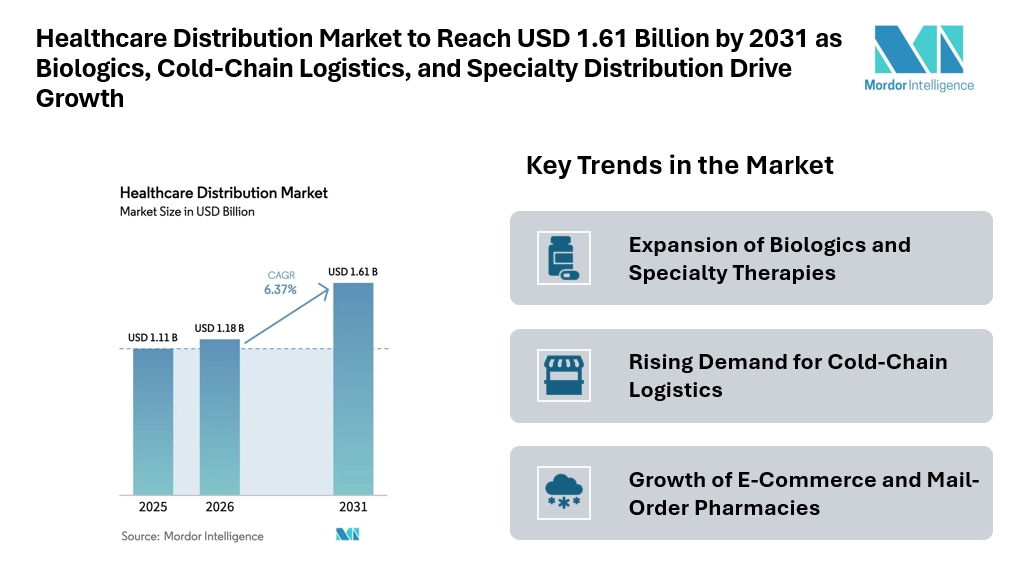
Hyderabad, India – 8 october 2026 – According to Mordor Intelligence, the healthcare distribution market size is estimated at USD 1.18 billion in 2026 and is expected to reach USD 1.61 billion by 2031, registering a CAGR of 6.37% during the forecast period. North America currently holds the largest share of the market, while Asia-Pacific is projected to register the fastest growth.
The healthcare distribution market covers third-party services that move pharmaceutical products, biopharmaceuticals, and medical devices from manufacturers to dispensing and care sites. The market is benefiting from rising pharmaceutical expenditure, growing demand for biologics and specialty therapies, increased use of e-commerce and mail-order channels, healthcare provider consolidation, and stronger requirements for supply-chain security and traceability.
Report Overview: https://www.mordorintelligence.com/industry-reports/healthcare-distribution-market?utm_source=abnewswire
Healthcare Distribution Market Trends
Expansion of Biologics and Specialty Therapies
The expansion of biologics, specialty medicines, and advanced therapies is changing the requirements of the healthcare distribution industry. These products often require specialized storage, temperature control, serialized packaging, and carefully monitored transportation. As pharmaceutical portfolios shift toward higher-value therapies, distributors with specialized infrastructure are gaining greater importance.
Monoclonal antibodies, recombinant proteins, vaccines, biosimilars, and cell and gene therapies are creating demand for distribution networks capable of maintaining product integrity throughout the supply chain. This is encouraging distributors to invest in ultra-cold storage, IoT monitoring, reverse logistics, and contingency routing.
Rising Demand for Cold-Chain Logistics
Cold-chain logistics is becoming one of the fastest-growing areas of the healthcare distribution market as temperature-sensitive therapies become more common. Biologics, vaccines, cell therapies, and other specialty products require validated packaging and controlled transportation conditions, increasing demand for specialized distribution infrastructure.
Distributors are integrating temperature sensors, GPS-enabled monitoring, automated warehouse systems, and real-time alerts into their operations. Reusable packaging and route optimization are also gaining attention as companies seek to reduce product loss, transportation costs, and environmental impact.
Growth of E-Commerce and Mail-Order Pharmacies
The expansion of e-commerce and mail-order pharmacies is changing traditional healthcare distribution models. Chronic-care medicines are increasingly being delivered directly to patients, creating demand for smaller, more frequent, trackable shipments instead of conventional bulk replenishment.
Online pharmacy networks are encouraging distributors to strengthen automated fulfillment, inventory forecasting, and last-mile delivery capabilities. Retail pharmacies are also developing omnichannel models, increasing competition between traditional distribution networks and digitally enabled supply chains.
Increasing Focus on Supply-Chain Security
Regulatory requirements for serialization, electronic verification, and track-and-trace capabilities are encouraging healthcare distributors to invest in digital supply-chain infrastructure. The need to protect pharmaceutical products from counterfeiting and maintain detailed transaction records is making technology an increasingly important part of distribution operations.
Distributors are adopting interoperable tracking platforms, cloud-based systems, and automated data exchange to improve visibility across the supply chain. These capabilities are particularly important for manufacturers and pharmacies that lack the resources to manage regulatory data requirements internally.
Healthcare Provider Consolidation Strengthens Direct Distribution
Healthcare provider consolidation is increasing the purchasing power of hospitals and integrated healthcare systems. Larger healthcare organizations are seeking distribution partners that can provide centralized procurement, inventory management, data integration, and specialized logistics services.
This shift is encouraging distributors to move beyond conventional wholesaling toward broader service models. Vendor-managed inventory, clinical support, reimbursement assistance, and supply-chain analytics are becoming increasingly relevant to distributor selection.
Healthcare Distribution Market Segmentation
By Product Type
-
Pharmaceutical Product Distribution Services
-
OTC Drugs
-
Generic Drugs
-
Branded Drugs
-
Biopharmaceutical Product Distribution Services
-
Recombinant Proteins
-
Monoclonal Antibodies
-
Vaccines
-
Medical Devices Distribution Services
Pharmaceutical product distribution services currently account for the largest share of the market, while biopharmaceutical distribution is expanding more rapidly as specialty therapies and biologics gain a larger role in healthcare spending.
By Service Type
-
Warehousing & Storage
-
Transportation & Freight
-
Cold-Chain Logistics
-
Reverse Logistics & Returns
Warehousing and storage represents the largest service category, while cold-chain logistics is recording stronger growth as distributors handle a greater volume of temperature-sensitive products.
By End User
-
Retail Pharmacies
-
Hospital Pharmacies
-
Other End Users
-
Long-Term Care Facilities
-
Ambulatory Surgery Centers
-
Other Institutional Buyers
Retail pharmacies currently account for the largest share, while hospital pharmacies are expanding rapidly as integrated healthcare systems increase direct procurement and centralized purchasing.
By Distribution Channel
-
Traditional Full-Line Wholesalers
-
Specialty Distributors
-
Mail-Order & Online Pharmacy Networks
-
Direct-to-Hospital Channels
-
Other Distribution Channels
Traditional full-line wholesalers remain important, but specialty distributors and direct-to-provider channels are gaining ground by combining physical distribution with clinical support, reimbursement services, and adherence programs.
By Delivery Mode
-
Non-Cold Chain
-
Cold Chain
Non-cold-chain services represent the larger portion of the market, while cold-chain delivery is expanding as biologics, vaccines, cell therapies, and other temperature-sensitive products gain wider adoption.
By Geography
-
North America: United States, Canada, and Mexico
-
Europe: Germany, United Kingdom, France, Italy, Spain, and Rest of Europe
-
Asia-Pacific: China, Japan, India, Australia, South Korea, and Rest of Asia-Pacific
-
Middle East & Africa: GCC, South Africa, and Rest of Middle East & Africa
-
South America: Brazil, Argentina, and Rest of South America
North America currently represents the largest regional market, while Asia-Pacific is expected to register the fastest growth as healthcare infrastructure, pharmaceutical consumption, and distribution capabilities expand.
Healthcare Distribution Market Competitive Landscape
The healthcare distribution market share is moderately concentrated, with major distributors competing through geographic coverage, specialty distribution capabilities, cold-chain infrastructure, technology platforms, and value-added services. The expansion of specialty therapies is encouraging companies to invest in advanced logistics and data-driven supply-chain solutions.
Key Players
-
McKesson Corporation
-
Cardinal Health
-
Cencora
-
Owens & Minor
-
PHOENIX Group
These companies compete across pharmaceutical and healthcare product distribution, warehousing, transportation, specialty services, cold-chain logistics, and technology-enabled supply-chain management.
For more insights on the Japanese market report, please visit the Mordor Intelligence page: https://www.mordorintelligence.com/ja/industry-reports/healthcare-distribution-market?utm_source=abnewswire
Conclusion
The healthcare distribution market forecast indicates continued expansion as pharmaceutical expenditure rises and healthcare systems increasingly rely on specialized distribution networks. The shift toward biologics and specialty therapies is creating demand for temperature-controlled logistics, advanced tracking systems, and higher levels of supply-chain visibility.
North America is expected to maintain its leading position because of its established pharmaceutical market, integrated healthcare networks, and advanced distribution infrastructure. Asia-Pacific is projected to record the fastest growth as pharmaceutical consumption increases, healthcare infrastructure develops, and regional distribution hubs expand.
About Mordor Intelligence
Mordor Intelligence is a global market intelligence firm, founded in 2014, helping businesses make informed decisions through data-driven insights, industry expertise, and advanced analytics. With 550+ domain experts and on-ground specialists across 150+ countries, the company delivers comprehensive intelligence across aerospace & defense, agriculture, automation, automotive, chemicals & materials, consumer goods & services, electronics, energy & power, financial services, food & beverages, healthcare, hospitality & tourism, information & communications technology, and logistics.
Its offerings include syndicated industry reports and subscription platforms such as Synapse. Mordor Intelligence is ISO 9001:2015 and ISO/IEC 27001:2022 certified, a member of ESOMAR and the Market Research Society of India, and a four-time Great Place to Work® honoree. Learn more at mordorintelligence.com.
Media Contact
Company Name: Mordor Intelligence Private Limited
Contact Person: Jignesh Thakkar
Email: Send Email
Phone: +1 617-765-2493
Address:11th Floor, Rajapushpa Summit, Nanakramguda Rd, Financial District, Gachibowli
City: Hyderabad
State: Telangana 500008
Country: India
Website: https://www.mordorintelligence.com/


